Nationally Recognized Student Research Is Helping Shape Institutional Improvement at PAU
What happens when students become active partners in improving their university?
At Palo Alto University, a nationally recognized research project is helping answer that question.
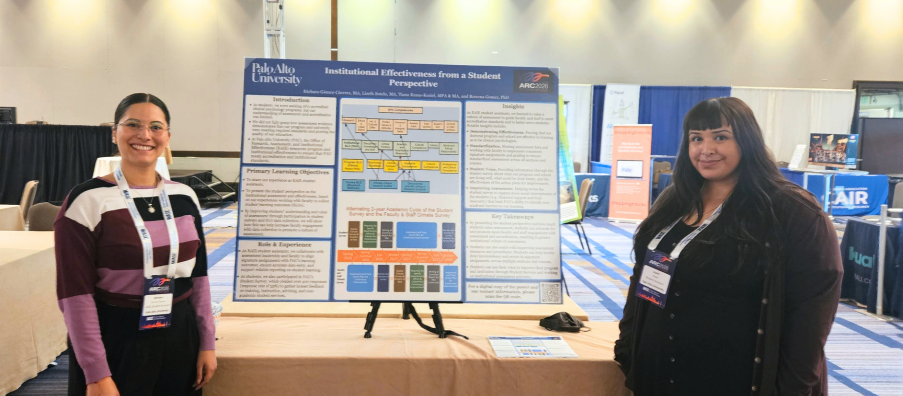
At the 2026 WSCUC Academic Resource Conference, PAU students Bárbara Gómez-Cáceres and Lizeth Sotelo, together with Rowena G. Gomez, PhD, Assistant Provost of Assessment and Institutional Effectiveness and Professor, and Tiana Kraus-Kozioł, Director of Academic & Strategic Effectiveness, received Outstanding Poster Presentation recognition for their presentation, Institutional Effectiveness from a Student Perspective.
The award recognizes more than an outstanding research presentation. It highlights the power of collaboration between students, faculty, and staff, and demonstrates how student perspectives can help shape meaningful institutional improvement.
Traditionally, presentations on institutional effectiveness and accreditation are led by faculty members or university administrators. PAU's presentation stood apart by placing students at the center of the conversation and demonstrating how they contribute to assessing academic quality, collecting meaningful evidence, and identifying opportunities to strengthen the student experience.
"The emphasis is on the student voice and how important that is in terms of being an important measure of the effectiveness of the programs that they belong to, but also the effectiveness of our institution," Dr. Gomez said.
For Dr. Gomez, institutional effectiveness extends beyond measuring student learning. She believes a university's responsibility is not only to educate students, but to support them throughout their journey at PAU and beyond.
For many students, completing a survey or providing feedback can feel like a routine task with little visible impact. This work demonstrates the opposite.
Institutional assessment is often associated with accreditation and compliance, but at PAU it serves a much broader purpose. Through the Office of Research, Assessment, and Institutional Effectiveness (RAIE), the university supports research, assessment, accreditation, institutional effectiveness, and academic research support while helping faculty, staff, and students use evidence to strengthen academic quality, improve the student experience, and guide meaningful decision-making.
The impact extends well beyond the award itself. Insights gathered through institutional assessment and student participation are already helping inform decisions about how PAU supports students, strengthens academic programs, and invests in new resources. Rather than collecting data solely to meet accreditation requirements, the university uses assessment to identify needs, evaluate effectiveness, and drive continuous improvement.
One example is the development of PAU's new Research Design & Data Analysis Center, which will expand research methods and statistical support for students. During discussions about the new center, Dr. Gomez explained that the initiative grew from recognizing students needed additional support, informed through institutional assessment data and student voice.
Another example is the university's Writing Studio, which was developed in part through assessment findings that identified a need for additional writing support, particularly during the dissertation stage. Together, these initiatives demonstrate how assessment can move beyond measuring outcomes to driving meaningful institutional improvements that directly benefit students.
The recognition also highlights the collaborative work taking place within RAIE. Led by Dr. Gomez, with support from Tiana Kraus-Kozioł, the office serves as a university-wide resource supporting research, assessment, accreditation, institutional effectiveness, and academic research support. Working alongside student assistants, the team helps faculty, staff, and university leadership collect and interpret evidence, strengthen academic quality, improve the student experience, and guide continuous institutional improvement.
As student assistants within RAIE, Bárbara Gómez-Cáceres and Lizeth Sotelo worked alongside faculty and university leadership to collect and analyze learning outcomes data, collaborate with instructors across academic programs, and help ensure assessment efforts translate into meaningful improvements for students. Their work offered a unique perspective on how institutional assessment can become a collaborative process between students, faculty, staff, and university leadership.
The project has already extended beyond the WSCUC Conference. The team also presented its work during PAU's Assessment Summit, and Dr. Gomez plans to expand the research through a forthcoming publication exploring the role of student participation in institutional effectiveness for higher education leaders across the country. This work will also help inform PAU's ongoing accreditation efforts.
For Dr. Gomez, perhaps the most important outcome is not the award itself, but what it represents.
Too often, students question whether completing a survey or sharing feedback will make a difference. This recognition demonstrates what is possible when students, faculty, and staff work together to improve the university experience. Student perspectives are more than a source of information. They can influence decisions, inspire new resources, and contribute to meaningful improvements that benefit future generations of students.
National recognition may have brought attention to this work, but its lasting impact is much closer to home. Every assessment completed, every survey submitted, and every student perspective shared contributes to a deeper understanding of how PAU can better support its community. As new resources like the Research Design & Data Analysis Center take shape and existing services continue to evolve, this work serves as a reminder that meaningful institutional change does not begin with a report. It begins by listening.