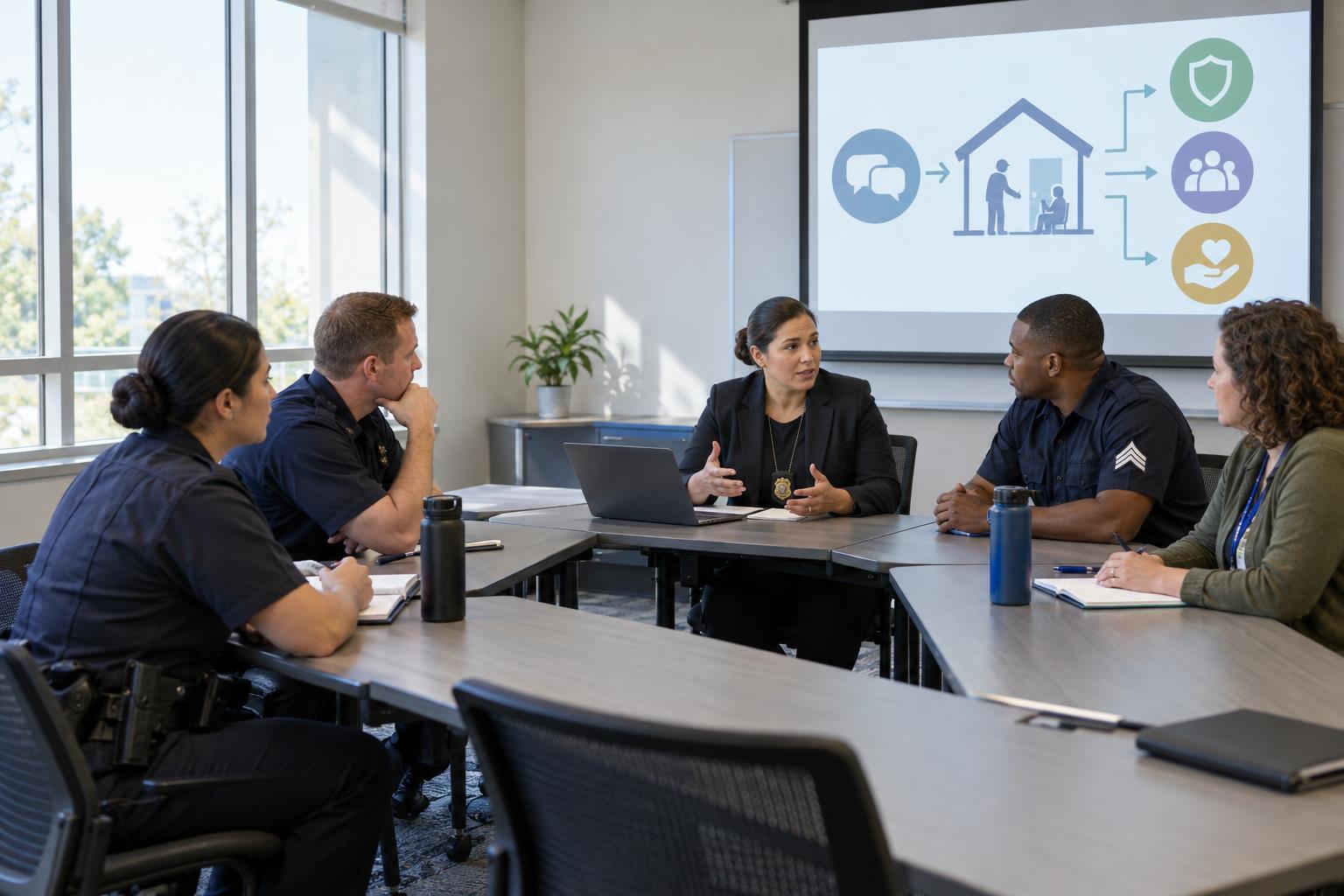
- What should a training director consider when training an organization of forensic psychologists?
- Professional Development or Organizational Capability: When does an organization need group training instead of individual continuing education?
- What makes a threat assessment training program relevant to forensic psychologists?
- How should a clinical director decide between generalized and more specialized threat assessment training for their staff?
- How important is case formulation when training an entire forensic psychology team?
- Can existing training content be customized for a large organization?
- What should training directors know about on-demand, versus live, group training online?
- How can a training director demonstrate that the training was worth the investment?
- What should a director ultimately look for in a training partner?
- Additional Resources
What should a training director consider when training an organization of forensic psychologists?
First, define the organizational need. Forensic psychologists work in a wide range of roles. That variety of roles matters when a director considers staff development. A forensic hospital may need psychologists to improve how they formulate violence risk and communicate recommendations to Courts and treatment teams. A court-connected forensic evaluation clinic may be focused on report writing and defensible opinions. A university, school district, or workplace threat assessment team may need staff to understand how specific threat assessments differ from traditional violence risk assessment. All of these organizations could reasonably search for “forensic psychology risk assessment training,” but they are not necessarily looking for the same solution.
The better conversation with a potential training partner begins with the organization's current practice. Where is there variation in staff skill level? What are the professional expectations of staff psychologists? What outcomes does leadership want to improve, such as clearer and more defensible risk formulations, robust management recommendations, or more communication between clinical and legal teams? What would meaningful improvement look like to organizational stakeholders? A detailed conversation with a training provider can help determine whether an existing course will meet the organization’s needs or whether a customized program would better reflect its staff’s experience levels, populations served, referral questions, and workflows.
Professional Development or Organizational Capability: When does an organization need group training instead of individual continuing education?
Continuing education (CE) remains an important part of professional development. Psychology is not a static field, and continuing education helps clinicians stay current as research and practice evolve. But a staff director has another consideration that an individual learner does not: consistency.
Suppose 25 psychologists across several programs are conducting violence risk assessments. Five have extensive training in structured professional judgment. Several learned about the HCR-20 years ago. Others primarily rely on clinical experience. Some may have additional training in threat assessment, while others have never received formal instruction. Sending each person to a different course might increase the number of trained individuals, but it does not necessarily create a common approach.
A group training program can address a different organizational need. Forensic psychologists can learn the same conceptual framework through the same cases, ask questions in the same setting, and develop a common vocabulary for discussing assessment and management.
Establishing a common approach does not mean every organization needs to train all staff together. Specialized or individual training may be more appropriate when employees have different roles or development needs. Leadership should determine whether the goal is to strengthen an individual practitioner’s skills or build a consistent capability across the organization.
What makes a threat assessment training program relevant to forensic psychologists?
The distinction between violence risk assessment and threat assessment is one of the first things an organizational director should clarify. Violence risk assessment is now conducted across settings that extend well beyond traditional criminal forensic evaluations. These assessments increasingly involve forensic hospitals, correctional settings, workplaces, healthcare systems, and schools. There is also a shift from simply predicting violence toward understanding the circumstances under which violence may become more or less likely and using that formulation to inform prevention. That distinction is important when evaluating a training curriculum.
If an organization primarily needs general violence risk assessment skills, a structured professional judgment curriculum may be appropriate. The HCR-20 V3, for example, provides a framework for considering historical, clinical, and risk-management factors. If the organization's concern is targeted violence, however, the training question may be different. A program may need to address warning behaviors, pathways toward violence, grievance, fixation, communications, and other aspects of behavioral threat assessment.
For leadership planning in-house training at a larger organization, the key question is not simply whether a provider offers “threat assessment” training. Leaders should determine which type of threat assessment the curriculum addresses and whether that approach aligns with the organization’s setting, referral questions, populations served, and staff responsibilities.
How should a clinical director decide between generalized and more specialized threat assessment training for their staff?
An experienced training partner can be useful in cases when leadership is choosing between general and specialized training for staff. The HCR-20 V3 and a targeted-violence threat assessment curriculum should not necessarily be viewed as competing products. They may answer different questions.
A general violence-risk framework can be useful when the organization's referrals involve an individual's broader likelihood of violence and the factors that may increase or decrease that risk over time. Targeted threat assessment may become more relevant when the concern centers on a particular target, pathway, grievance, or movement toward an intended act.
When thinking about selecting the right training, a director should consider that the assessment framework should follow the problem their organization is asking its staff psychologists to solve. A good training conversation should help leadership make that determination rather than simply steering them toward whichever program happens to be available.
How important is case formulation when training an entire forensic psychology team?
For a large organization, the distinction between introductory training and a more meaningful competency-building program may be one of the most important considerations.
Knowing the risk factors is not the same thing as knowing how to formulate a case. The psychologist needs to determine what information is relevant to the referral question, how different factors interact, what circumstances might increase or decrease concern, and how the resulting formulation translates into management. This distinction shows that risk assessment is more than assigning a high- or low-risk label and emphasizes formulation, scenarios, and management.
Case-based training is particularly useful for a forensic psychology department. A psychologist may understand the definition of a risk factor and still struggle to decide whether it is relevant in a particular case. But a group discussion of a complicated case allows participants to see how experienced evaluators reason through ambiguity, conflicting information, and competing explanations. This group dialogue also creates an opportunity for leadership to identify where the department is already consistent and where additional training may be needed.
Can existing training content be customized for a large organization?
Customization does not always require building a training program from scratch. In many cases, an organization can start with an established curriculum and adapt it to how its staff work. Customization may mean changing the cases used in training, emphasizing different assessment questions, adjusting the instructional sequence, or combining live discussion with material that staff can complete independently.
This customization approach can be especially useful in large forensic systems, where the challenge is often not a lack of training content but the need to make it relevant across different roles, experience levels, or facilities. For example, an organization working to improve the consistency of forensic evaluations might begin with established instruction on an assessment framework, then incorporate cases that resemble its own referrals and add opportunities for staff to compare formulations, discuss reports, or receive feedback on their application of the material.
The delivery model can also be adapted. Some organizations may benefit from an initial live training followed by recorded or on-demand material for new hires and staff who cannot attend at the same time. Others may want a common foundational program followed by smaller case-based sessions for more experienced clinicians. Competency checks, report review, or supervisor-led follow-up can also be incorporated when the goal extends beyond exposure to the material and toward more consistent practice.
For a director considering threat assessment training, the more useful question may therefore be less about whether a provider offers a completely customized curriculum and more about how thoughtfully existing expertise can be adapted to the organization. A strong starting point is to identify what should remain standardized across the team and where the training needs to reflect the cases, responsibilities, and decisions staff encounter in their own setting.
What should training directors know about on-demand, versus live, group training online?
The answer is not necessarily “live is better” or "asynchronous, online is better.” The more useful question is what the organization is trying to accomplish with the training and which delivery format best suits that goal.
Asynchronous, online training can be particularly practical when staff are distributed across facilities or have difficulty being released from clinical responsibilities at the same time. Live instruction, whether online or in-person, can create something harder to reproduce asynchronously: discussion among professionals confronting similar problems. For a large organization, a combination may make the most sense. Foundational material can be delivered in a standardized format that participants can take as their schedule allows and at their own pace, while live sessions can be reserved for case discussion, application, and organization-specific questions.
How can a training director demonstrate that the training was worth the investment?
Demonstrating return on investment (ROI) for an organizational training is an area where group training differs most clearly from an individual CE purchase. If one psychologist spends several hundred dollars on a course, the decision is largely personal. When an organization commits substantial resources to training an entire workforce, leadership may reasonably want to know what changed.
Measuring organization-wide improvement can be difficult, particularly when senior leaders expect outcomes related to clinical quality, regulatory compliance, or violence prevention. A single training program cannot independently produce or reliably demonstrate changes in broad outcomes because staffing levels, supervision practices, patient populations, institutional policies, and access to treatment also influence those outcomes.
Directors can instead evaluate indicators more closely connected to the training. For example, staff may demonstrate greater knowledge on pre- and post-training assessments, identify relevant risk and protective factors more consistently, produce clearer case formulations, connect assessment findings to specific risk-management recommendations, or make fewer recurring errors during supervisory report review. Leadership can also examine whether psychologists use a common vocabulary during case conferences and whether supervision and peer review reinforce a shared assessment process.
What should a director ultimately look for in a training partner?
Selecting group training for a forensic psychology team involves more than choosing an available course. Leadership should identify a training provider that can understand the organization’s specific challenges and develop a comprehensive training solution aligned with its staff roles, populations served, workflows, and desired outcomes. A useful provider should be able to talk with leadership about the population being served, the professional roles involved, the organization's existing level of expertise, the desired outcomes, and the practical constraints on training. The training should distinguish between an established curriculum and an opportunity for customization. The discussion should explain how the training can move from a one-time educational experience to something the organization can continue to use.
In forensic psychology, the work is varied and consequential. For a director considering threat assessment group training for forensic psychologists, the starting point should therefore be the organization's actual practice: what staff is currently doing, where greater consistency is needed, and what skills the organization wants to develop. From there, the conversation with a training partner can become much more specific.
Leaders should determine training needs by considering questions such as whether their staff needs foundational violence risk assessment training? More advanced threat assessment and management? Targeted violence and behavioral threat assessment? Case formulation? Report writing? A customized program delivered across multiple sites? A live training supplemented by online material that staff can revisit later?
For a large forensic organization, the real value of group training is the ability to take expertise that already exists in the field and translate it into a consistent, practical approach for the people responsible for applying it. The most useful training starts with understanding what the organization is trying to accomplish, then determining what kind of training will support that goal.
Additional Resources
eBook
Training
- Risk Assessment Training Bundle
- Violence Risk Assessment Certificate
- Recent Advances in Threat Assessment and Management: Workplace, Campus, and School Violence
- Assessing Psychopathy: PCL-R & PCL-SV for Risk & Diagnosis
- AAFP: Advanced Threat Assessment and Management
- Self-Care for Threat Assessment and Management Professionals
- Violence in the Workplace
- Violence in Higher Education
- College Campus and Workplace | Violence Risk Assessment
Blog Posts
- What Should Forensic Psychologists Consider When Conducting Violence Risk Assessment and Threat Assessment Across Legal, Institutional, and School Settings?
- An Introduction to Violence Risk Assessments
- Sexual Violence (RSVP-V2 & SVR-20-V2)
- What are the Roles and Responsibilities of a Forensic Psychologist?
- Should Forensic Psychologists Use the Millon Clinical Multiaxial Inventory-IV in Criminal Court Evaluations?
- General Violence Risk: A Structured Professional Judgment Approach
- Clinical and Forensic Evaluations: What’s the Difference?
- The Importance of Continuing Education in Mental Health Careers
- CONCEPT and PAU Celebrate Launch of University’s New Division of Continuing and Professional Studies at AP-LS
- Add to Your Career in the New Year
- PAU Professor, Donna Sheperis, PhD, Presents at Technology and Mental Healthcare Forum
- PAU at AP-LS: Embracing Leadership, Collaboration, and New Research
- PAU Professor Lynn C. Waelde Leads Community-Wide Stress Reduction Initiative
- What is Online Training?
- Case Study: RSVP Training Australia
- Training Influences Technique When it Comes to Police InterrogationTraining Influences Technique When it Comes to Police Interrogation
- Case Study: The State of New Jersey
- Case Study: The State of Utah
- Case Study: The State of Colorado

.jpeg)